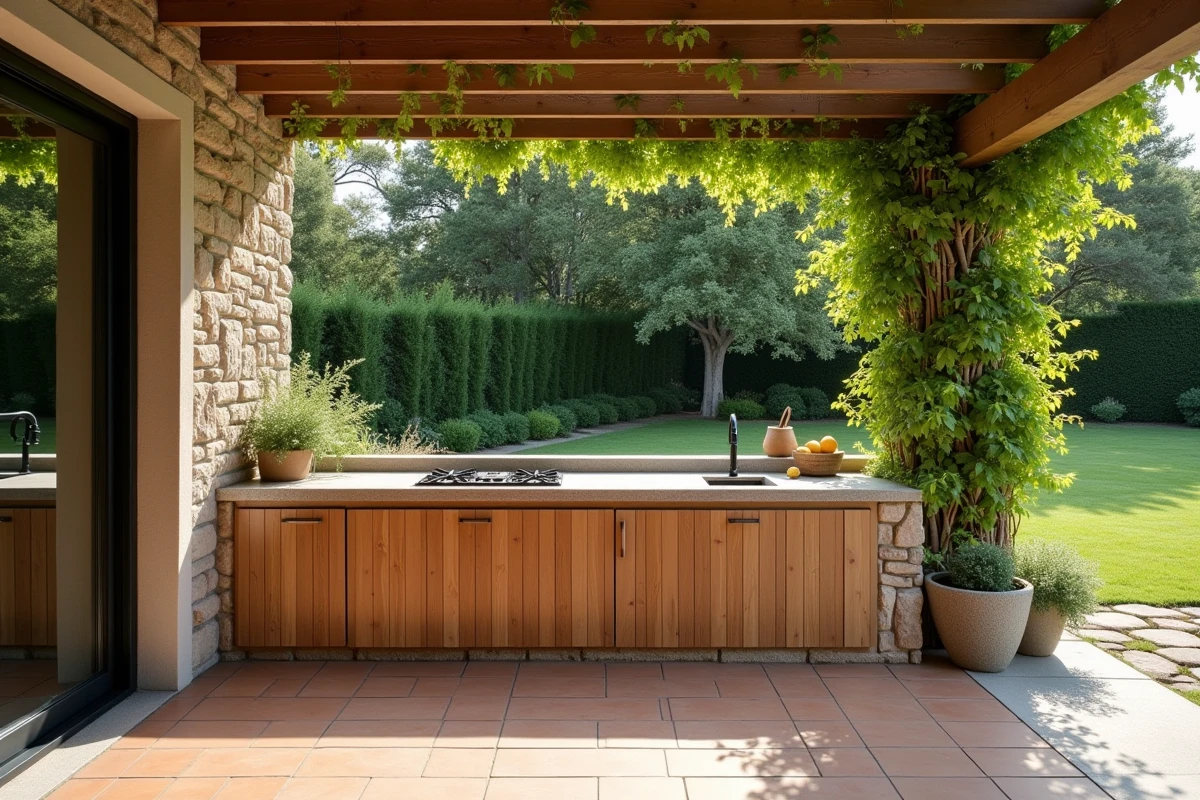
A fixed summer kitchen, as soon as it creates floor space or ground coverage, falls within the scope of constructions as defined by the Urban Planning Code. This qualification leads to two direct consequences: an obligation to declare or obtain a permit depending on the surface area, and a possible modification of the cadastral rental value of the property, which is the basis for calculating several local taxes.
The distinction between a mobile installation (a wheeled plancha, a removable serving area) and a construction anchored to the ground (masonry, concrete slab, fixed connections) determines the entire applicable tax regime. Understanding this boundary avoids costly regularizations.
Cadastral rental value and summer kitchen: the tax mechanism
The foundation of local taxation is based on the cadastral rental value. This value represents the theoretical annual rent that the property could generate on the market. Any new construction that increases the habitable or usable area of a property raises this value.
A covered summer kitchen, connected to water and electricity, with a slab and walls, constitutes a declared surface in the cadastre. The tax administration takes it into account during the revision of the property’s assessment file.
The question of taxation of summer kitchens arises mainly at the time of the completion declaration, as this declaration triggers the cadastral update with the property tax center.
In practical terms, property tax increases proportionally to the added surface area. The impact depends on the municipal coefficient and the cadastral category assigned to the construction. A basic summer kitchen (simple covered shelter) will be classified differently from a closed and insulated room.

Development tax on a summer kitchen: thresholds and calculation
The development tax applies to any construction, reconstruction, or expansion operation subject to urban planning authorization. It is calculated by multiplying the taxable area by a fixed annual value per square meter, then by the rate voted by the municipality and the department.
For a summer kitchen requiring a prior declaration or building permit, this tax is payable in one or two installments depending on the amount. Key points to remember:
- The taxable area corresponds to the sum of the enclosed and covered floor areas with a ceiling height exceeding 1.80 m. An open kitchen without walls may, depending on the case, partially escape this calculation.
- The fixed value per square meter is revised annually by ministerial order. It differs in Île-de-France and the rest of the territory.
- The municipal rate and the departmental rate are set locally, leading to notable differences from one city to another.
The development tax is not a recurring tax: it is paid only once, after the authorization is granted. In contrast, the increase in cadastral rental value has effects every year.
Second homes and furnished rental housing: special cases
Since the gradual abolition of the housing tax on primary residences, the addition of a summer kitchen mainly impacts owners of second homes. The housing tax on second homes remains due, and its amount follows the cadastral rental value. A summer kitchen that increases this value mechanically raises the annual bill.
For owners who engage in furnished rentals, the tax reasoning takes on another dimension. Income from a furnished rental falls under either the micro-BIC regime (with a flat-rate deduction on income) or the real regime (with deduction of actual expenses). In both cases, the existence of a summer kitchen enhances the property and can justify a higher rent.
Under the real regime, the construction or renovation costs of a summer kitchen are considered amortizable or deductible expenses depending on their nature. The construction cost is amortized over the useful life of the property, while furniture and equipment (plancha, refrigerator, sink) follow their own amortization period.
Tourist residences and seasonal rentals
Residences intended for tourism are subject to specific provisions. The law regulates rental income from classified and non-classified tourist accommodations with distinct deduction thresholds. Adding a summer kitchen to a property offered for seasonal rental improves the attractiveness of the accommodation but requires verification that the construction complies with the local PLU and any restrictions related to environmentally sensitive areas.
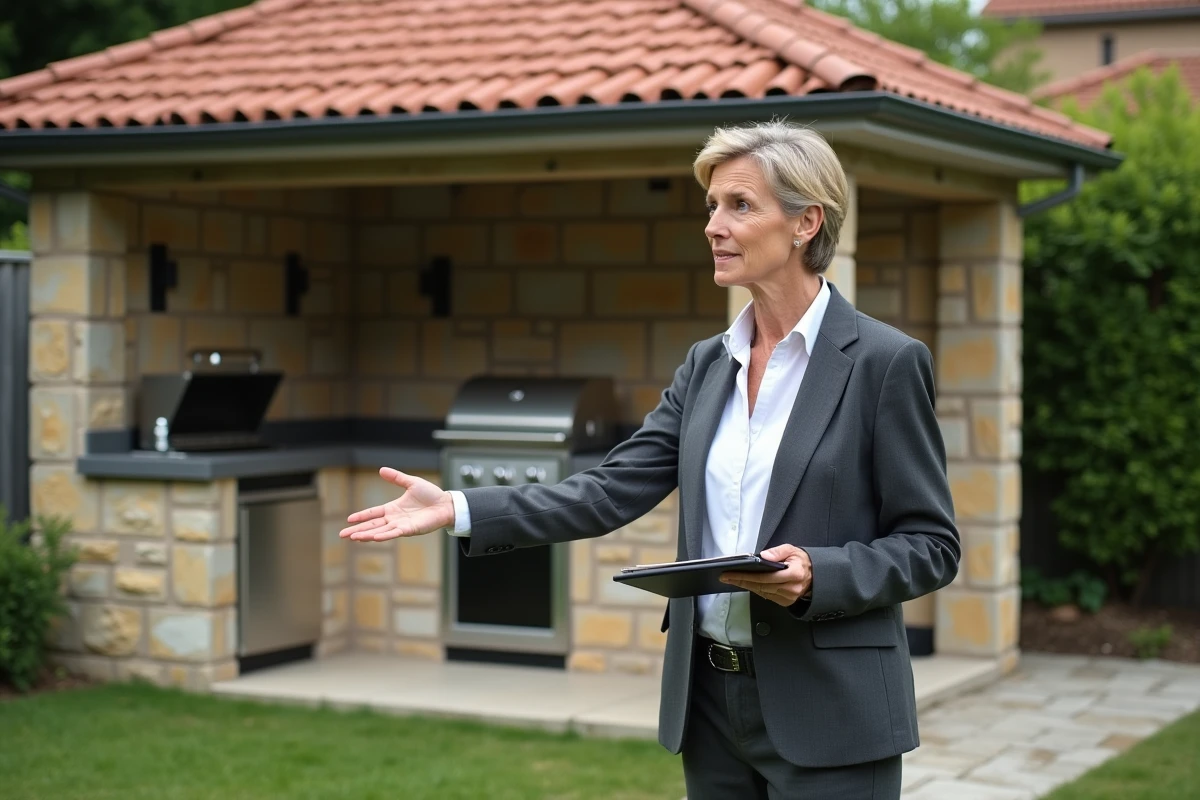
Co-ownership and zero net artificialization goal: unknown constraints
In co-ownership, installing a fixed summer kitchen on a terrace or private garden is not solely a matter of urban planning. The operation may alter the external appearance of the building or affect common areas. It therefore requires a vote in the general assembly, often by a majority under Article 25 of the 1965 law. A co-owner who carries out these works without the co-ownership’s authorization incurs liability, even if the town hall does not require a permit.
Moreover, recent developments in Local Urban Plans increasingly incorporate the zero net artificialization (ZAN) goal. Some municipalities now restrict annex constructions, even below the usual permit thresholds, to limit space consumption and impermeable surfaces. A summer kitchen on a concrete slab in a garden may be refused for this reason, even with a modest footprint.
- Check the co-ownership regulations before any project, even on a private garden.
- Consult the current PLU on the municipality’s website to identify any ZAN restrictions.
- Anticipate the processing time: a prior declaration generally takes one month, a building permit two months.
The choice between a mobile summer kitchen and a fixed construction is not merely a question of comfort or budget. It determines the entire applicable tax regime for the property, from the development tax to the annual property tax, including the housing tax on second homes. Before pouring a slab, a careful reading of the PLU and a visit to the municipality’s cadastral service remain the most reliable starting point.